Scott Group - Energy Conversion Interfaces

Research focus
In the Scott group, we are fascinated in general by the processes that convert one type of energy to another – and specifically the electron transfer step at the core of any electrochemical reaction.
We strive for fundamental understanding of the mechanisms of these reactions and the interfaces at which they occur. We will, for example, detect products real time by mass spectrometry and track the interface in-situ by UV-vis spectroscopy.
Group leader
Søren Bertelsen Scott
Assistant professorOffice: C220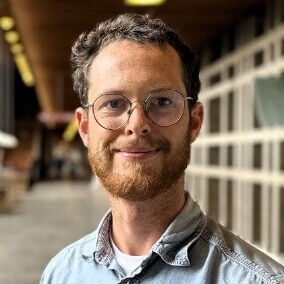

Research area
Since the industrial revolution, fossil fuels have served as a source of energy, releasing CO2, and as the starting materials for most of our chemicals. The green transition taking place now will turn this on its head: Renewable electricity from wind and solar will serve as the energy source needed to build all the chemicals we need from the sustainable starting materials of air, water, and CO2.
Electrocatalysis, the interdisciplinary field describing how electrical energy can drive chemical reactions at the interface between a solid electrode and a fluid reaction medium, is the science at the core of this revolution.
This includes the reactions that generate hydrogen (H2) and oxygen (O2) from water in an electrolyzer as well as emerging technologies that, for example, directly convert CO2 to high-value chemical feedstocks like ethylene, a gas which is a precursor to many types of plastic.

In the Scott group, we are fascinated in general by the processes that convert one type of energy to another – and specifically the electron transfer step at the core of any electrochemical reaction. We strive for fundamental understanding of the mechanisms of these reactions and the interfaces at which they occur.
We will, for example, detect products real time by mass spectrometry and track the interface in-situ by UV-vis spectroscopy. We integrate data science and machine learning into our approach, and develop open source software packages for the benefit of the research community.
We work closely with the Rossmeisl, Jensen, and Pittkowski groups in the Center for High-Entropy Alloy Catalysts (CHEAC) to discover improved electrode materials and thus accelerate the green transition.
Projects
You can do all kinds of projects within experi-mental electrochemistry and Power-to-X. We work closely with other PI’s in Center for High Entropy Alloy Catalysis (CHEAC) to discover improved electrode materials and thus accelerate the green transition.
Collaborations
We collaborate with other universities and research institutions in Denmark and Europe e.g.:
- DTU
- Ruhr-Universität Bochum
- Imperial College London.
Contact
-
Phone+4535328548
-
E-mailsbs@chem.ku.dk
-
Employee profileSee all information