

Some guts are better than others at harvesting energy
HEALTH New research from the University of Copenhagen suggests that a portion of the...
We perform research in the field of physical chemistry. Our research is aimed at understanding atmospheric radical reactions. We are able to determine the reactivity of molecules and radicals in a range of different reactions by determining reaction rate constants.
Our research is also aimed at determining properties of atmospheric molecules and hydrogen-bonded complexes to achieve a better understanding of the mechanisms of aerosol formation.
Our current research is divided into two categories:
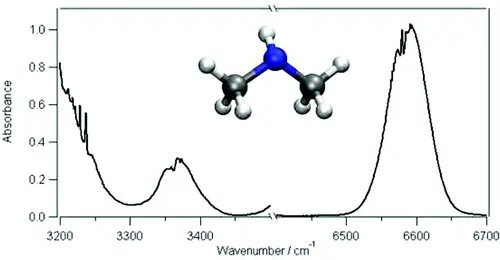
With our full or reduced dimensional local mode (LM) models, we are able to determine accurate frequencies and intensities of various vibrational transitions. Of particular interest are the XH-stretching transitions, which typically provide most of the spectral intensity beyond ~2500 cm-1.
XH-stretching vibrations have a characteristic high frequency relative to the additional molecular vibrations, and coupling to these vibrations is typically negligible. Thus, even the simplest LM model, i.e. a 1D LM model, often provides an accurate description of XH-stretching transitions.
More vibrational modes are included in our LM models when an increased accuracy is needed, or when infrared spectra are difficult to assign solely based on experimental grounds. The absolute intensity of vibrational transitions is proportional to the integrated absorbance of the corresponding experimental band and inversely proportional to the pressure of the molecule.
Absolute intensities of observable bands can therefore be determined experimentally by recording gas-phase FTIR spectra of isolated molecules.
Networks of hydrogen-bonded molecules are found in molecular clusters in the atmosphere and the thermodynamic stability of the clusters is determined by the strength of the formed hydrogen bonds.
The molecular clusters are precursors to aerosols, which have a huge impact on our climate due to their ability to absorb and scatter solar radiation. Aerosol particles remain large sources of uncertainty in climate models today and determining the hydrogen bonding abilities of a range of different molecules will help limit these uncertainties and thereby improve current climate models.

In order to achieve a better understanding of the formation of clusters in the atmosphere, the Kjaergaard group have investigated a number of different hydrogen bonded complexes in the gas phase and determined the equilibrium constant of their formation to help predict if they play a significant role in cluster formation and growth in the atmosphere.
In the group we use conventional absorption spectroscopy as well as matrix isolation spectroscopy to examine the complexes as well as theoretical investigations using our local mode model to predict wavenumbers and oscillator strengths of molecular vibrations.
We use conventional FTIR spectroscopy to examine hydrogen bonded complexes as well as matrix isolation spectroscopy, which is helpful when detecting very unstable complexes.

Reduced carbon species are emitted to the atmosphere from biogenic and anthropogenic sources in huge quantities. These are oxidized in the atmosphere by various different processes such as autoxidation reactions (repeated addition of O2 and H-shifts to a molecule), and the oxidized products have a much lower volatility than the reduced species.
Low-volatility compounds play a significant role in the growth of secondary organic aerosols (SOA). SOA affect the radiative balance of the earth, yet quantitative assessment of the effect of SOA on the climate remains a challenge.
In the Kjaergaard group we calculate rate constants of various different radical hydrogen shift reactions in order to determine the most likely products, which are formed from the autoxidation of different reduced carbon species. This contributes to understanding of the processes which happen in the atmosphere and the way that the formed species affect the radiative balance of the earth.

One of the processes we have studied, is the autoxidation of 3-pentanone (shown in the picture above) with the final reaction product being 4- hydroperoxypentane-2,3-dione. Addition of O2 to radical species happens very fast, making the radical hydrogen shift reaction the ones that determine the overall rate of the autoxidation.
In order to determine the rate constants of the hydrogen shift reactions we have developed a cost-effective approach to the implementation of multi conformer transition state theory (MC-TST), which includes tunneling.
FTIR spectroscopy is a technique, which measures how much infrared radiation a sample absorbs at each wavelength. It consists of a light source, which hits an interferometer consisting of a beam splitter. Here the infrared radiation from the light source is divided into two beams resulting in an optical path difference between the beams.
The beams hit a mirror and are recombined and directed towards the sample. Behind the sample a detector records the repetitive interference signals from the collected beams, which is subsequently decoded into an absorption spectrum by Fourier transformation.
We use this technique to study the fundamental vibration and lower vibrational overtones of atmospherically relevant molecules as well as hydrogen-bonded complexes.
In Matrix Isolation Spectroscopy a sample is trapped in a large medium of inert gas such as Ar, which is then cooled down to 12 K. This results in the sample being trapped in the rigid matrix of Ar. By heating the matrix, the molecules can move around and form complexes. The sample can then be examined spectroscopically whilst trapped in the matrix.
Additionally, our microwave discharge instrument can be coupled to the matrix and can be used to form an inert gas plasma. This can for example be used to create OH radicals, by adding a flow of water vapor through the plasma. We use the matrix isolation technique to examine reactive or unstable species such as hydrogen bonded complexes or radicals as the matrix stabilizes the species by separating them.
UV-Vis spectroscopy is a technique, which measures how much ultraviolet and visible radiation a sample absorbs at each wavelength. A light source is directed into a monochromator, which only allows a very narrow range of wavelengths to go through it. After going through the monochromator the light passes through a sample and into a detector. The intensity of the light passing through a sample is compared to the intensity of the light before it passes through the sample and an absorbance spectrum is recorded.
We use this technique to study the electronic transitions in different species as well as XH-stretching vibrational overtones.
Photoacoustic spectroscopy is a technique, in which a pulsed laser or modulated laser is directed towards a gaseous sample. When light is absorbed by the gas sample, the excited molecules will subsequently relax to the ground state either by emission of photons or by means of non-radiative processes.
The non-radiative processes produce localized heating in the sample, resulting in an increase in the local pressure of the sample. By using a pulsed/modulated laser, the sample pressure will also modulate creating a sound wave. This sound wave will have the same frequency as the initial light modulation, making it possible to use a microphone to generate an absorbance spectrum of the gas sample.
The photoacoustic signal can be amplified by tuning the modulation/pulse of the laser, so it will resonate with the gas sample.
We apply this technique, when we want to explore high vibrational XH-stretching overtones.
We have very recently installed a cavity ring-down spectrometer in our lab. Cavity ring-down spectroscopy (CRDS) is a very sensitive technique. A short laser pulse is directed into a cavity between two highly reflective mirrors. Every time the laser pulse reaches a mirror a small fraction of the light leaks out through the mirror.
In an empty cavity the decay rate of the laser light between the mirrors is dependent only on the reflectivity of the mirrors but when absorbing sample is present, the decay happens faster. The decay of the light intensity measured on the other side of the mirror is converted to absorbance. A factor that significantly adds to the sensitivity of this technique is the effective optical path length, which reaches up to orders of several kilometers with a cavity length below one meter.
This also means that the sample volume does not have to be large in order to record a spectrum of it using CRDS.
We apply this technique, to measure low intensity XH-stretching vibrational overtones.
Monochromatic light is directed at a sample where it interacts with vibrations and other excitations in the system, which changes the wavelength of the incident light. On the other side of the sample a detector measures the wavelength and intensity of the radiation.
Elastically scattered light with the same wavelength as the incident light is filtered out.
We have used Raman spectroscopy in the CN-stretching frequencies to characterize dihydroazulene and vinylheptafulvene derivatives.
The high-performance CPU cluster enables us to run high-level quantum mechanical calculations in Gaussian 16 and MolPro 2012/2020 amongst others.
We have access to 6400 CPUs with a total of 30 TB RAM, out of which 608 CPUs and 10 TB are within the group, and the rest are shared with the Department of Chemistry.
We have used our high-performance CPU cluster to calculate reaction rates in atmospheric radical reactions as well as calculate vibrational transitions, energies, and geometric values of molecules of spectroscopic interest.
Spectroscopic insights into methyl-induced tuning of O-H⋅⋅⋅π hydrogen bond
Dhritabrata Pal, Anne S. Hansen, Leon S. Andersen, Henrik G. Kjaergaard
Journal of Molecular Structure, 1358, 145168 (2026),
DOI: https://doi.org/10.1016/j.molstruc.2025.145168
Calculated Absorption Cross Sections and Photolysis Rates of Hydroperoxyaldehydes
Nanna F. Christensen, Raphael Odai, Kelvin H. Bates, Henrik G. Kjaergaard
J. Phys. Chem. A, 130, 1, 111–120 (2026),
DOI: https://doi.org/10.1021/acs.jpca.5c06770
Atmospheric Autoxidation Chemistry of Diethyl Ether
Hongmin Yu, Jing Chen, John D. Crounse, Thomas Golin Almeida, Henrik G. Kjaergaard, Paul O. Wennberg
ACS EST Air, 2, 11, 2566–2576 (2025), DOI: 10.1021/acsestair.5c00204
Relative Rate Coefficients for the Reactions of HO2 Radicals with Hydroxy-Substituted Alkyl Peroxy Radicals, and for Reactions of OH Radicals with Hydroxy Hydroperoxides
Geoffrey S. Tyndall, John D. Crounse, Theo Kurtén, Henrik G. Kjaergaard, Paul O. Wennberg
ACS EST Air, 2, 10, 2219–2229 (2025), DOI: 10.1021/acsestair.5c00158
Application of the Local Vibrational Mode Framework for the Spectroscopic Estimation of Free Hydroxyl Group Fractions in Pure Liquid Methanol-d3
Evangelos Drougkas, Henrik G. Kjaergaard, Henrik G. Bohr, Michael Bache, Nicolas Von Solms, Georgios M. Kontogeorgis, Xiaodong Liang
J. Phys. Chem. B, 129, 41, 10824–10837 (2025), DOI: 10.1021/acs.jpcb.5c0305


The Kjaergaard Group's laboratories and offices are located on the fourth floor of the C-building (Building 2) of the H. C. Ørsted Institute building complex.
Department of Chemistry
University of Copenhagen
Universitetsparken 5, 2100 Copenhagen.
Social activities